Tuesday, May 26, 2009


Krakow Cracow

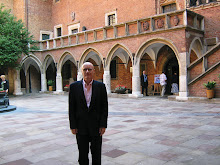
One morning, a few days ago, I was sitting with fellow Shoah scholars and educators in a 14th Century chapel- like lecture hall in one of the oldest universities in Europe. We were all waiting for the Chief Rabbi of Poland to open the 2009 Conference on “the Legacy of the Holocaust,” a biennial conference sponsored by the University of Northern Iowa and Jagiellonian University in Krakow, Poland. Moments before we had stood in the inner courtyard below, somewhat amazed to learn that Nicolaus Copernicus probably conversed as we did about what was going on in Krakow, and of course, possibly wondering where we all were in relation to the Universe.


Our few days in Krakow were breathtaking, as we not only were treated to the delights and charms of a few days at a European university, but as well, we were able to engage each other in a variety of interdisciplinary subjects of research on the Shoah, or the Holocaust. Scholars from Israel, Norway, the Netherlands, Germany, the U.K., The Czech Republic, Australia, Poland, Austria and the U.S. participated in two days of on-going research connected to the conference theme of “Family and the Holocaust.”

When not in academic sessions, we left the 14th Century University to enjoy the beautiful and historic town center with its Cloth Hall, churches, horse drawn carriages and perhaps the best lunch anyone can find in this beautiful city.

Conference participants had the opportunity for a day trip to the nearby shtetls (small Jewish villages), a walking tour of the Krakow Jewish Ghetto during World War II, as well as the Plaszow Labor Camp (featured in “Schlinder’s List”) or a visit to the death camp, Auschwitz-Birkenau. I chose to revisit Auschwitz as I had just finished teaching a short, introductory course on the Holocaust at my university, and wanted to see if I could absorb any more of the history of this Hell on Earth. On this visit, we were privileged to have one of the best and most informed guides of the Museum who explained to us the many displays and artifacts that are part of the old Polish Army Fort, or Auschwitz I.

I must admit this is one of the oddest places on earth, as the Auschwitz Museum attracts travelers, tourists, and scholars from all over the world. Perhaps the oddest sense is what one sees in the parking lot outside the admissions building. At any time of the day we could see 20 or more buses parked neatly to accommodate the many visitors who come to this place. And in order to hear our guide over the other 20 or so guides leading tours, we all wore headphones in case we wandered too far from our leader. Of course Auschwitz was a tower of Babel, with few hardly able to understand the various barking order of the German SS officers. But I will admit that as we walked through the Polish barracks to see photographic and artifact evidence of what happened here, I couldn’t help but see hundred of adolescents as well as parents and grandparents who were making their somber way through building after building.

Let me say this, that every single display of horror and torture was stunning, paralyzing, and profoundly disturbing. I still cannot get out of my mind a blurry photo taken by a prisoner (how was that possible?) of naked women running across a field. The image simply brought on the same immediate response I had when I last saw it. I’ve not seen another picture that has ever created such an instant overwhelming emotion. The open windows of the second floor exhibits provided fresh, cool air, knowing that other barracks contained similar kinds of evidence of this Final Solution. The room sized display of shorn hair was also deeply disturbing, knowing that what was collected had not yet been shipped to Germany for a variety of macabre purposes.

Our afternoon visit included a guided tour of Birkenau, or Auschwitz II, the expanded death camp where more than a million or million and a half were slaughtered in the gas chambers and crematoria, or survived as slave laborers in the IG Farben Factory complex. We walked through the public latrines, barracks, and slowly made our way toward the Final Solution, where we could see the destroyed gas chambers and crematoria. A few of us left our tour guide, and wondered further back and to the fourth and fifth gas/crematoria buildings, one of which was destroyed by fearless sonderkommandos who were Jewish prisoners who had to handle the grisly task of moving the dead from the gas chambers to the furnaces. Briefly, the whole walk was quite chilling. I’ve presented this information to underclass juniors at the university where I teach, but still, standing and breathing at this place is quite different than standing and breathing while talking about this place in far away Wisconsin.

After showers and clean clothes following our “tour,” we all gathered at the Galicia (the province of Poland we were in) Jewish Museum back in Krakow for kiddush and motsi (blessing of wine and challah before the Jewish Sabbath), and a delightful buffet before a guided tour of a photographic exhibit of images of Jewish life and culture in Poland. Later, we were treated to an hour concert of Yiddish songs, the perfect way to end this extraordinary day.

Almost every morning I would rise quite early and jog along the Vistula River, passing cyclists, other joggers, and men sweeping their restaurant/bar boats anchored along the banks. My jog became longer and longer each morning as I felt more confident that I would not get lost, counting bridges going and coming back, passing by the Jewish Quarter, and the Wawel Castle, where I would visit in the last hours of Krakow.

My colleague Ron Berger presented his work on second generation Holocaust survivors with a talk about how his father and uncle survived their horrific experiences, one in Birkenau (Auschwitz II) and the other by surviving in forests for the duration of the War. Following his talk we continued with our last morning and afternoon concurrent sessions on a variety of Shoah topics, including my own artistic interpretation of fusing the lyrics of the Tao de Ching with Chinese-like lyrics of images of Auschwitz. By the end of the day, I suggested we find one of the many evening concerts to balance all the intensity of the various presentations, so we listened to arias and oratorios by a gifted female soloist and her organ accompanist as a fitting way to balance all of the presentations earlier in the day.

The next morning I ran even further on my route, perhaps in exasperation and exhaustion for the last few days, but also, to just keep tiny little embolisms from breaking out in my legs or lungs as we were flying home at 36,000 feet. A few hours later I sauntered up to the Wawel Castle in time to observe one of the Sunday masses at the Royal Cathedral. Following the service I wandered toward the front of the nave, taking in all of the royal and Catholic history with the different chapels and ancient crypts. When visiting Poland, one always wants to return with jewelry made from amber, so I returned to the Cloth Hall in the Market Square to find something that might glimmer in the sunlight, finishing off the visit to Krakow with a delightful café au lait in a bookstore filled with the different languages of Europe. I wasn’t ready to return home, but then I found myself in a cab dashing to the airport in time to follow the sun all the way back to Chicago. Perhaps I have forgotten to mention how many large Polish Zywiec beer steins I emptied.

Wednesday, April 8, 2009

Where Were You at Sunrise This Morning?

Where Were You at Sunrise This Morning?

Just a few hours ago, Orthodox, and some non-Orthodox Jews around the world celebrated the rising of the Sun as they had not done so since 1981, for that was the last time the Sun was in, according to the Talmud, the exact position in the Heavens as it was when it was first put into orbit by The Creator. Of course this is a bit different from the Sun worshippers on Summer Solstice, for most of them are just glad to have a long day of sunlight, as the days will start to get shorter and shorter until mid December. But we can also be reminded of a celebration of the sun known as the Festival of Sol Invictus, an ancient winter solstice holiday that was later designated as Christmas Day.

But even before that, we had Egyptian priests stepping out into the morning dawn in full priestly garb, awaiting the Sun Creator Ra in hopes that the sun would return from a long night in the underworld, or whatever the Sun chose to do when not lighting the Egyptian Kingdom. Perhaps the Sun worshippers today perform the same rituals as did our ancient priests, just glad to have the warmth return again after a chilly night.

Sun worship was quite essential to the ancient Hindus, for Surya did not only kept the Sun on a timely calendar, but also battled against forces of darkness for his followers below. And of course the Incas certainly had their closest to the Sun worship, high up in the Andes.

We’ve gotten away from saying thanks for the light, so even though we might be a bit late with our Birkat Hachamah, Hebrew for the blessing of the Sun, it wouldn’t hurt if all of us stepped out of our shelters for just a moment and looked up to the sky, even if the Sun has already lighted your way. Or I suppose it wouldn’t hurt if you tried it on your own tomorrow morning, for we will all have to wait another 28 years before we have this opportunity again. If you can’t say the Hebrew, then just follow along with the transliteration:

"ברוך אתה ה' אלהינו מלך העולם עושה מעשה בראשית"
"Blessed are You, LORD, our God, King of the Universe who makes the works of Creation."

Sunday, March 22, 2009

Wardrobe Malfunction Alert

WARDROBE MALFUNCTION ALERT!

A few days ago I was presenting my last class on Islam trying to make connections between European Colonialism, the long occupation of Algeria, the surge of Algerians into French culture, and finally some of the unique challenges France faces today in the Islamic community. After presenting a few clips from both sides of the “European Islamophobia, debate” and asking students to write a journal entry on what was most provocative, stimulating or educational about the last four weeks of their study, I was ready to “wrap up” our short introductory course. Putting my books away, a student came up to me, looking as though she wanted to actually whisper something private. She did. “Professor, your fly is open.”

I first tried to remember if she said she worked in a senior care center, as the discreet message seemed like something a seasoned nurse would tell an old man. But in any case, I dashed up two flights of stairs, student papers covering up any embarrassment, and finally found the culprit…a 1 ½ wide zipper expansion, but thank heavens for colored under ware and long shirt tails. I returned to the classroom for an Act II of the same Lecture, but now, more knowingly confident that I was not exposing young minds to needless guffaws.

But then, do guys have wardrobe malfunctions very often? Is it old age that keeps the zipper from returning to the top position? It seems that the young and beautiful goddesses of Hollywood and TV Land are the most prone to the malfunctions, with straps breaking, or buttons revealing either the color of panties, or in Britney Spears’s case, actually no panties. Most of the accidents reveal one nipple, but in my quick survey of these types of fashion bloops, I don’t recall any two nipple faux pas.

Guys live for these female accidents, as all guys would probably admit, from pre adolescent to geezer. These are what guys live for, for that ultimate moment of being in the beautiful right place when something snaps and the world is perfect for a second or two, but for the guys who don’t have the paparazzi around, well, it’s just more of a failure to return the zipper to the starting position. I have wondered if this is a special subcategory in the DMV IV manual of psychiatric disorders, but perhaps it’s just part of our multitasking world that we live in, that we forget to check how we appear to others when stepping out into the public.

If we quickly take a gaze across the thousands of internet links on “wardrobe malfunction,” one could begin to imagine that clothing manufacturers were actually conspiring to have their attire featured on the latest gossip news. It’s not just thin shoulder straps, as I’ve seen or heard of shoes flying off feet in the middle of a crucial “Dancing with the Stars” number, or when some of the most beautiful models in the world, slip and slide down a highly polished stair case as they are aspiring to win Miss Universe, or something like that. Of course pratfalls in high heels don’t quite constitute wardrobe malfunctions, as that’s more of hardware than a software problem.

Knowing that I was going to be reported to the University Morals Police, I quickly confessed to my colleagues in order to have the report on file before any students began filing reports on their own internet gossip networks. Little did I realize that wardrobe malfunctions have happened more often than I would have ever expected. One professor wrote back when she remembered an incident in junior high when all the buttons on her blouse popped off like a popgun. What she remembers the most are the two evil boys in the back who yucked all afternoon. Another professor recalled a “teaching moment” when her half slip just slipped off her body into a lovely pile of lace around her shoes. And a guy has just confirmed that I do not have early Alzheimer’s when he reported that he taught a whole day of composition classes with his zipper unzipped for all to ponder. By the way, one professor offered the best coping technique when finding out one is blowing in the wind. Simply pirouette, look down, zip everything back in place, turn, and wait for the catcalls from the classroom. That seems reasonable. But to clarify, don’t catch any skin down there as that might result in a more dramatic and unexplainable situation, otherwise known as the “There’s Something About Mary” syndrome.

Yet in an odd sort of way, perhaps this is the reverse of what will happen soon on campuses all across the country this spring, when we’ll see more and more from both the top and behind, as I’ve unfortunately witnessed far too much to keep my mind on some intellectual or theoretical concept. On these spring days and soon to be summer days, we’ll see more than we can ever see in one balmy afternoon than we’d ever see from the occasional malfunction. But perhaps the most amusing incident comes from a now long gone faculty member who howled and howled with delight when she recalled one summer outdoor class when a young man in Bermuda shorts forgot to put on anything underneath. Perhaps we can all agree that might be the most eyebrow-raising wardrobe malfunction of all time.

So all of this has some meaning, doesn’t it? The world is becoming unbuttoned, unstrapped, unzipped, un-slipped, un-shoed, and even slightly under-dressed. Early visions of the senior care home? Let’s hope not, but it does remind us of how little material remains between the skin we cover, and the skin which brings a smile to all of us, either an embarrassing one, or a hoo-rah for others. So everybody, before we step out into the public, let’s check our straps, laces, buttons and zippers for who knows who’s out there dreaming of our personal nightmare.

Monday, January 12, 2009

O Babylon

O Babylon

In a short “arts, briefly” item that appeared in the January 8, 2009 New York Times, we’ve learned that Babylon may be coming back to life, perhaps as a walk through museum. Of course news about any other place on the planet is of much more newsworthy notice, but if you’ve ever admired rocks in the Middle East, as I have, then this news is of great international consequence. Some who are more familiar with the daily news of four millennia from this locus of the world may say it’s about time, while others may see Babylon as just another bygone of the Ancient World.

But take notice, the U.S. State Department has agreed to funnel $700,000 towards the renovation of this spectacular city, and perhaps this is good news as the Occupation Forces of the 1st Marine Expeditionary Force caused considerable damage to the ancient ruins. Perhaps all of us should chip in one American dollar to the World Monuments Fund so this extraordinary city of the 2nd Millennium B.C.E. can be brought back to its important nexus to world history.

After all, it was the “gateway of the god[s],” perhaps as significant as The Bodhi Tree, or Mount Olympus, or Mount Sinai or Mount Moriah or any other site that reminds us of what the ancient world considered holy and magnificent. Of course it’s also a confusing place, causing much consternation among the peoples of the world, just as much as it did for the characters in the recent global screenplay, “Babel.”

We should give some credit to the city planners, for Babylon at one time was the city of the World, the largest city of the World, but then I’m sure ancient cities of the Far East and Africa had equivalent marvels which we should address sometime soon. While many scholars of the Bible will say the Torah, or for Christian readers, the Old Testament, is sui generis, it is noteworthy that much of the literature that came out of Babylonia found its way, indirectly and subtlety into the Book of Genesis and possibly even Exodus, with reference to the Code of Hammurabi, perhaps the first legal code of the Ancient World. Of course the Code isn’t at the site right now, but neither is anything else.

If it wasn’t for Lord Byron, or Sennacherib, we wouldn’t have such great poetry, or misguided battle tactics in the failed storming of Jerusalem when “The Assyrian came down like the wolf on the fold/And his cohorts were gleaming in purple and gold.” Anyone who knows the story knows that Jerusalem was saved momentarily, in part, connected to the {un-}glory of Babylon.

By the early 600’s (of the B.C.E.’s) the green thumb Nebuchadnezzar II provided for one of the wonders of the world, the nectarian Hanging Gardens, but of course, that’s a story that hasn’t been completely verified. Yet if it wasn’t for Nebuchadnezzar, we might never had heard the unbelievable arias of Giuseppe Verdi’s “Nabucco,” which connects more and more of us to the stony palaces, though few of us want to remember the origin of the opera and Israel’s defeat and exile as is so movingly depicted in Act III with the Chorus of “va pensiero.”

And where would a few of us be today had it not been for the magnanimity of Cyrus the Great who sent the Israelites packing back to Jerusalem after their 1st Exile as noted in Isaiah and Jeremiah? Many of the Jewish holidays, as well as counting any of the days of the week, or months, or years, can possibly be found in the long 70+ year exile in Mesopotamia. Perhaps we need to ask a scholar to take us through parts of The Babylonian Talmud, or even the origins of Genesis and Eden which would take us back to The Enuma Elish and the Babylonian story tellers who were just trying to figure out those very first days in the desert.

For a look at Babylon from Hollywood, get out your DVD copy of Oliver Stone’s “Alexander” and watch the famed warrior/globe trotter enter the magnificent gates of Babylon, as well as seeing all the beauty that it was in the 3rd century before the C.E.

Yet who doesn’t remember the Deutsche Orientgesellschaft and the German team that began excavations in the late 19th Century? But perhaps the oddest of all inscriptions, in our own era, is by a follower of the great past: “This {partial restoration of Babylon} was built by Saddam Hussein, son of Nebuchadnezzar, to glorify Iraq.”

Of course there are other sites to get excited about, and The World Monuments Fund is certainly a place to learn about the many different restoration projects going on in this world, in our own time, but if you’d like to see Babylon brought back to its stony glory, then by all means, see what you have left in your retirement fund, and consider a small donation. Yes of course, the U.S. economy has tanked, or will tank, and how can you give something for heritage, but if you can, then perhaps we can find a way to restore what once was the “gateway of the god(s).”

Thursday, December 25, 2008

Vatican Shifts Stance on Heretical Astronomer

Vatican Shifts Stance on Heretical Astronomer

In a stunning success for science vs. faith, the Vatican is now ready, or willing, to acknowledge that planet Earth does revolve around the Sun, and not as the Church believed 400 years ago. But the news coming out of the Vatican doesn’t exactly put it that way, in fact, no mention is made in any of the recent reports that Galileo Galilei’s observations were accurate, or assumed to be correct, or favored a scientific view that could be easily replicated. Instead, in a recent deliberation at the Vatican, “Science 400 Years After Galileo Galilei,” Vatican scholars came to believe that the astronomer was “one of the faithful.”

This comes after a trial of heresy, a sentence to life imprisonment, then a reduced sentence to house arrest. I am not certain if he was able to keep his telescope. What seems an odd addendum to all this is word that L'Osservatore Romano recently published a story about alien life in the outer universe. All this comes about as Pope Benedict XVI is working toward correcting a perception that he is anti-reason, or more simply put, an opponent of science. Perhaps the alien story was a stretch.
Even so, with all the preparation, excitement and hoopla for Galileo Galilei, some Vatican officials aren’t as forgiving as the Pope.

To help celebrate the 400th anniversary when he pointed his refracting telescope to the Heavens, the United Nations is calling 2009 The Year of Astronomy, with papers and presentations all over the world celebrating the mix of (some) faith and (plenty of )science. Then what happened to the statue of Our Astronomer tentatively planned for the Vatican Gardens? It appears that, according to the Vatican newspaper, “The dramatic clash between Galileo and some men of the Church left wounds that are still
open today.”

Who, pray tell, is still seething? Who, pray tell, is still pouring pride into the “wound”? Just how long will this go on? Regardless of the naysayers, we’re hopeful the statute will go up, and in the Gardens. I do forget the layout of the Vatican Grounds, but perhaps on a sunny day, the soon to be standing statue might be viewed on the same azimuth as the Obelisk in St. Peter’s Square, if one has the courage to make such a climb.

One of the more impressive statues in the Square, this is an Aswan granite guide to the Time of the Day which once graced the Temple of the Sun at Heliopolis, before Emperor Caligula brought it to Rome as booty in 37 C.E., and later was moved by Pope Sixtus and countless slaves to St. Peter’s Square in 1585. Galileo Galilei was about 21 at the time, fourteen years before he set his eye to the Heavens. I’ll have to check if the young Italian was on hand to witness the big move. In the meantime, when you’re visiting Florence again, or for the first time, be sure to stop in the Museum of History and Science to catch up on Galileo’s life and scientific discoveries. Perhaps the Museum has moved a Bible into one of the displays to confirm that the Astronomer read from the Book of Genesis.

Sources: msnbc.com, and “moving the Vatican Obelisk,” from a blogsite “on landscape and architecture.

Monday, December 22, 2008

Obama Chooses Family Friend for Inaugural Poet

Obama Chooses Family Friend for Inaugural Poet


With much excitement, anticipation, toes crossed and breath held, we all wondered who might be selected as the poet for Barak Obama’s Inauguration. Would it be the new Library of Congress Poet Laureate, Kay Ryan, or her predecessor, Charles Simic? Would Maya Angelou be invited back for a repeat of “On the Pulse in the Morning”? Who has the fortitude to stand before 4-6 million shivering Americans and world guests to listen to the waxing and waning of “an occasional poem,” as they are so terribly named? Who even memorizes poems these days as Robert Frost did on a cold January in 1961? Is there such an American poet who has been vetted of appropriate metaphors and synecdoches for such an auspicious occasion?

Lyndon Baines didn’t even want to waste time with such triviality at his Inauguration. And Ike? Does anyone remember a poet honoring the great General? Well perhaps this is unfair, for who remembers the Benediction at any of the Inaugurals? Okay, can anyone out there (without Goggling) remember a line from any of the Presidential Inaugural speeches, with the exception of “Ask not….”? Lines do seem to fade once the party’s over, don’t they?

So we do have a Presidential Inaugural Poet, and she is Elizabeth Alexander of Yale University who has a remarkably fine list of honors and achievements, and you can find more about her by going to the www.npr.org site
and searching for her interview on Thursday, Dec.18. But I was just wondering, what do you think would be appropriate images or even lines of the Inaugural Poem?

Who could forget Maya Angelou’s?

Here, on the pulse of this new day
You may have the grace to look up and out
And into your sister's eyes, and into
Your brother's face, your country
And say simply
Very simply
With hope --
Good morning.

A favorite image is seeing old man Frost reading from memory his closing lines of such solemnity:

Such as we were we gave ourselves outright
(The deed of gift was many deeds of war)
To the land vaguely realizing westward,
But still unstoried, artless, unenhanced,
Such as she was, such as she would become.

Those lines do sound today a bit heavy handed with the piano key-iambic hitting just the right stresses. But heck, it was cold out, and we never got to hear the poem he wished to read, as he didn’t wear sunglasses for the intense snow glare that day. Anyone remember “Dedication”? It’s even more somber, if that’s possible. What is it about “the state of somberness” which gets these Inaugural poets bringing out the chariots, or cheerleaders? Sorry!

Now Miller Williams had it right, when he stepped up to the podium for Bill’s Second Inaugural. The photo of Bill sitting behind Miller who is reading is near priceless for “rapt attention of a poet reading a poem.” Here’s a stinger of Miller’s:

But where are we going to be, and why, and who?
The disenfranchised dead want to know.

Ah, now we’re getting somewhere. Let’s talk about the dead, a favorite for all poets.

And then there was James Dickey of all people, standing up for Jimmy Carter in 1977, choosing not to read a piece written for the occasion, but instead, pulling out a favorite of his, “The Strength of Fields,” with a rip roaring closing line of

My life belongs to the world. I will do what I can.

Now I am getting goose bumps; aren’t you? Okay, enough of this inaugural poetic torture. What would you like to read at the mike? Do you have an inaugural line? A title? Please submit your lines, images, metaphors and synecdoches, and I’ll try my best to cut and paste something that might catch the attention of the Academy of American Poets, for who knows what we might be able to create? We might be making inaugural poetic history here.

Please, though, no “hope springs eternal” lines. We’ve gotten the point on that one. Also, no blubbering. No whining. No chest puffing. Nothing too bellicose. Please, only one personification per poet, please. Think out of the sonnet box. Be grand, but not too grand. Be strong but not too strong. Be fresh, like Ezra Pound (see college modern poetry textbook) insisted. Perhaps a little pedestrian, but some nobility as well, for a Kennedy is bound to be in the audience. No “send forth” instructions. We’ve already done that. Keep it family style, too, as we don’t want any nipples showing that might need to be covered, after all, the meteorologists predict the temps will be in the low 20’s. Finally, and with some reservation as a poet who loves long historical poems, keep it to two pages, please. The public isn’t ready for a modified epic, at least not when teeth are chattering. So here’s your challenge. Send a few lines, titles, noble thoughts, and we’ll try to paste together a hit for the Yes We Can Team.


----------------------------------------------------------------------------------------------------------------------------------------------------------

Sunday, December 7, 2008

Sir Gawain and the Green Knight Returns

Sir Gawain & The Green Knight Makes the Top 100 Notable Books of the Year

The news is quite astounding, and reflects much on the power of a good poem, written, some say, in the late 14th Century in a dialect few of us can converse in, but imagine the surprise when the newest translation of Sir Gawain and The Green Knight showed up on the New York Times Book Review “100 Notable Books of 2008.”

This calls for much celebration, not only among living poets, but all of us who take an interest in literature that lasts beyond the year of publication.
Let’s all find a copy (for some, look in an old college literature anthology, English Lit Vol. I) of the poem, and set aside time between New Year’s Eve Day, and New Year’s Day to savor some of the mind-tripping Middle English 101 stanzas that aren’t all that long, if you don’t mind a giant who loses his head, and some pretty steamy scenes, and a potential second beheading.

May I suggest we read it to our loved ones over whatever hot drinks when sipping throughout the New Year, but please, try to find a green scarf to help carry all of us back in time to knights, a lady fair indeed, and one very sharp axe that does draw blood.

Go ahead and stimulate the economy by actually buying the new translation by Simon Armitage (Norton, $25.95), but I am sure you can find other editions not quite so pricy if you look around. So as you are all making your trips for Holiday Merriment, be it Christmas or Hanukkah, or Winter Solstice, Saturnalia, or Kawanza, take time to bring in some firewood, find some extra lap warmers, see what kinds of English teas are tucked away in the back of the pantry, and see if there’s even time for baking a batch of scones.

With much anticipation, we begin:
No, I have come to this court for a bit of Christmas fun
fitting for Yuletide and New Years with such a fine crowd.
Who here in this house thinks he has what it takes,
has bold blood and a brash head,
and dares to stand his ground, giving stroke for stroke?
Here! I shall give him this gilded blade as my gift;
this heavy ax shall be his, to handle as he likes.
and I shall stand here bare of armor, and brave the first blow.
If anyone's tough enough to try out my game,
let him come here quickly and claim his weapon!
I give up all rights; he will get it for keeps.
I'll stand like a tree trunk -- he can strike at me once,
if you'll grant me the right to give as good as I get
in play.
But later is soon enough,
a full year and a day.
Get up, if you think you're rough,
let's see what you dare to say!"
(Paul Deane, trans., 1999)